
Contents
Use Cases in Corporate Finance.
Conversational AI and Chatbots.
Decision Tree for Selecting an AI Platform.
Artificial Intelligence (AI) is transforming how businesses operate, and SAP customers have a wide range of AI capabilities at their disposal. From automating financial processes to optimizing supply chains and enhancing customer interactions, AI-driven solutions can unlock significant business value. However, selecting the right AI use case and platform can be challenging, requiring a clear understanding of business needs, data availability, and SAP’s AI ecosystem.
This guide provides ideas and steps to getting started with AI in SAP, covering industry-specific applications, finance use cases, conversational AI, and a high-level decision tree to help choose a suitable AI platform.
1. Defining AI Use Cases
SAP customers should normally begin their AI journey by identifying relevant use cases that align with business objectives, data readiness, and available AI capabilities within their SAP landscape. The first step is to determine whether prebuilt AI solutions in SAP S/4HANA, SAP Analytics Cloud (SAC), SAP Concur, SAP SuccessFactors or other applications meet their needs, or if they require custom AI models. Validate if SAP AI capabilities on SAP BTP can be sufficient for implementing identified use cases.
For more advanced AI scenarios, such as large-scale machine learning, NLP-powered chatbots, and deep learning applications, hyperscalers (AWS, Azure, GCP) provide additional computational power, real-time analytics, and scalability beyond SAP’s native AI offerings.
Measuring AI project’s success involves defining clear KPIs, running pilot projects, and scaling AI solutions effectively to drive business value.
Example AI Use Case
| Business Challenge | Inaccurate cash flow forecasting affects liquidity planning |
| Available Data | Historical transactions, receivables, payables, economic indicators |
| AI Capability | Predictive analytics |
| Success Metrics | 90% forecast accuracy, 15% reduction in working capital requirements |
| Pilot Approach | AI model tested on past 12 months of financial data |
| Scaling Strategy | Rollout across global finance teams after successful PoC |
2. Use Cases in Corporate Finance
AI is transforming corporate finance by automating routine tasks, improving accuracy, and providing predictive insights that enhance decision-making. From financial forecasting to fraud detection, AI-driven solutions help businesses optimize cash flow, streamline accounting processes, and ensure compliance with regulatory requirements. The following use cases highlight how AI and machine learning are driving efficiency and business value across key finance functions.
1. AI-Powered Financial Forecasting & Planning
- Use Case: Predict future revenue, expenses, and cash flow based on historical data and market trends.
2. Automated Invoice Processing & Accounts Payable
- Use Case: Reduce manual work in invoice matching, approval workflows, and fraud detection.
3. AI-Driven Cash Flow & Liquidity Management
- Use Case: Predict cash inflows and outflows to optimize liquidity.
4. Fraud Detection & Risk Management
- Use Case: Identify fraudulent transactions and mitigate financial risks.
5. Intelligent Expense Management
- Use Case: Automate expense approvals and detect policy violations.
3. Conversational AI and Chatbots
AI-powered ERP chatbots enable organizations to improve sales, enhance operational efficiency, elevate customer satisfaction, and support real-time decision-making. When integrated with SAP S/4HANA Finance and SAP BTP, these intelligent chatbots automate financial queries, streamline workflows, and optimize user experience. Key finance use cases include:
1. Real-Time Financial Reporting & Insights
- Use Case: Executives and finance teams can ask the chatbot for real-time financial statements, balance sheets, or profit & loss summaries.
2. Automated Invoice & Payment Status Tracking
- Use Case: Vendors and finance teams can check invoice approvals, due payments, or payment statuses.
3. Intelligent Expense Management & Policy Compliance
- Use Case: Employees can submit and track expense claims via chatbot.
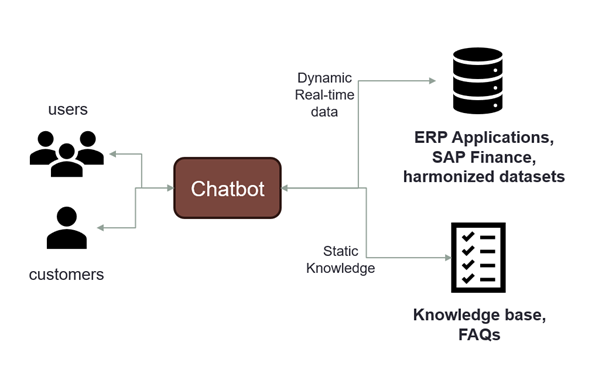
The chatbot architecture below enables real-time access to transactional finance or other ERP data, while adhering to predefined chat rules and leveraging a static knowledge base for accurate responses.
4. Decision Tree for Selecting an AI Platform
While SAP S/4HANA Embedded AI and SAP Analytics Cloud (SAC) offer built-in AI for predictive accounting, forecasting, and anomaly detection (varies for S/4 cloud vs. on-premise), more advanced scenarios require SAP AI Core, AI Foundation (BTP), and SAP Business Data Cloud (BDC) for custom AI models.
For large-scale AI workloads such as NLP, image recognition, and deep learning, hyperscalers (AWS, Azure, GCP) provide the computational power and flexibility needed to extend AI capabilities beyond SAP’s native solutions.
| Use Case | AI Requirement | Best AI Platform |
| • Predictive Accounting• Cash Flow Forecasting• Automated Invoice Processing• Smart GR/IR Reconciliation | Standard AI in SAP business processes | SAP S/4HANA Embedded AI, SAP Joule |
| • Sales & Demand Forecasting• Anomaly Detection• Predictive Maintenance• Financial Planning & Analysis | Predictive analytics & forecasting | SAP Analytics Cloud (SAC) AI |
| • AI-Powered Document Processing• Intelligent Chatbots• ML-Based Risk Scoring, classification• AI for Manufacturing Quality Control• AI-Based IoT Anomaly Detection• AI for Regulatory Compliance• AI-Driven HR Analytics | Custom AI models for SAP workflows | SAP AI Core & AI Foundation (BTP),SAP Business Data Cloud (BDC),Hyperscalers |
| • AI-Based Image & Video Recognition• Natural Language Processing (NLP)• Large-Scale Fraud Detection• AI-Powered Market & Sentiment Analysis | Large-scale AI & ML on cloud | Hyperscalers (AWS, Azure, GCP) |
Choosing the right AI platform depends on the specific business use case, AI complexity, harmonization of data sources, and integration requirements within the SAP ecosystem. This decision tree helps SAP customers identify the most suitable AI solution, from embedded AI in SAP S/4HANA for standard automation to hyperscalers for large-scale AI and machine learning applications.

AI offers SAP customers powerful capabilities to automate processes, enhance decision-making, and drive business innovation across industries. Choosing the right AI solution depends on business needs, data readiness, availability of relevant skills and appropriate SAP or hyperscaler platforms.
By following a structured approach: defining AI use cases, exploring industry applications, leveraging conversational AI, and using the decision tree for platform selection organizations can successfully integrate AI into their SAP landscape and maximize its value.